by Kevin
Share
by Kevin
Share
A Rotating Bento Box is a modern take on the traditional lunch container, featuring a 360-degree turntable base that allows users to spin and access different food compartments effortlessly. This design combines the aesthetic appeal of Japanese bento culture with the convenience of a “lazy Susan,” making it a popular choice for those who value variety in their meals. However, as its popularity grows, a discussion has emerged: is this innovative design the future of meal prep, or is it just a gimmick that adds unnecessary complexity to a simple lunchbox?
Features of a Rotating Bento Box
360-Degree Accessibility
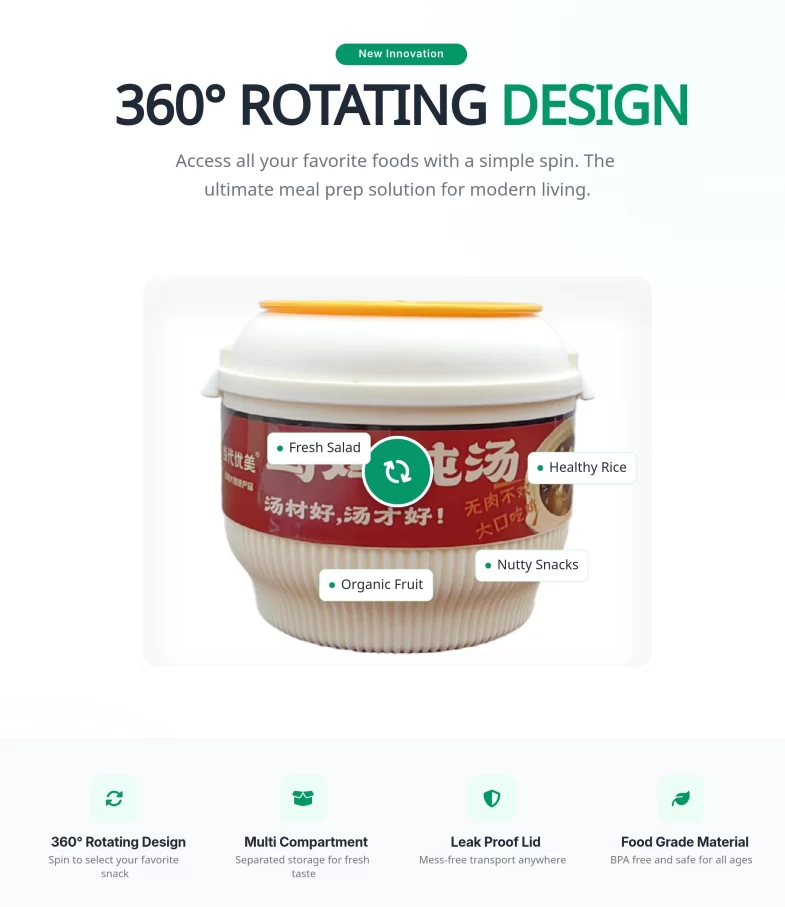
The standout feature is the rotating chassis. With a simple spin, you can switch between different dishes without needing to unstack layers or juggle multiple small containers, streamlining the eating experience.
Leak-Proof Compartments
To ensure food integrity, these boxes are designed with sealed compartments and silicone gaskets. This prevents liquids like sauces or soups from leaking into other sections, keeping flavors distinct and textures crisp.
Versatile Material Options
Rotating bento boxes are commonly available in food-grade polypropylene for lightweight durability and microwave safety, or stainless steel for superior temperature retention and a sleek, professional look.
Stackable and Space-Saving
Despite the rotating mechanism, many models are designed to be stackable and compact. They maximize vertical space, allowing users to carry a full meal—including snacks and desserts—in a single, organized unit.
How is a Rotating Bento Box made?
The manufacturing process requires precision to ensure the rotating mechanism works smoothly while maintaining a tight seal.
Injection Molding
The individual compartments and the outer casing are typically created using high-precision injection molding. This ensures that each section fits together perfectly, which is crucial for the rotation and sealing functions.
Assembly of Rotating Base
The turntable mechanism is assembled at the base. Manufacturers install bearings or a central pivot to ensure the spin is smooth and stable, preventing the box from wobbling during use.
Sealing and Quality Control
Silicone sealing rings are fitted into the lids, and locking clips are attached. Each unit undergoes rigorous testing to ensure the compartments are airtight and that the rotating mechanism does not interfere with the seal.
Popular Uses of a Rotating Bento Box
Office and Desk Dining
For professionals eating at their desks, the rotating design acts as a portable dining table. It allows for a multi-course meal experience without cluttering the workspace with multiple dishes.
School Lunches
The interactive nature of spinning the box makes lunchtime fun for children. It encourages them to eat a balanced diet by presenting different food groups in an engaging way.
Picnics and Outdoor Dining
The all-in-one design makes serving and cleaning up easy during picnics. The box itself acts as a serving tray, eliminating the need to bring extra dishes or bowls.
How to choose a Rotating Bento Box that suits your needs?
Assess Capacity Needs
Determine your typical portion size. If you have a hearty appetite, look for a model with larger compartments or multiple tiers. For light eaters or children, a single-layer rotating box may suffice.
Check Material Suitability
If you plan to reheat food at work, choose a BPA-free plastic model that is microwave and dishwasher safe. If you prefer keeping food cold or hot for hours, a thermal stainless steel version is a better investment.
Evaluate Seal Quality
Ensure the locking mechanisms are sturdy and the silicone seals are thick. A high-quality seal is essential to prevent messy leaks, especially if you carry wet foods like salads with dressing or stews.
How to care for a Rotating Bento Box?
Disassemble for Cleaning
Always take apart the compartments and remove the silicone seals before washing. Food particles can get trapped in the crevices of the rotating base or under the seals, leading to bacterial growth.
Gentle Washing
While many plastic models are dishwasher safe, hand washing is often recommended to preserve the integrity of the rotating mechanism and the sealing gaskets over time.
Thorough Drying
Ensure all components are completely dry before reassembling and storing. This prevents mold and mildew and ensures the rotating mechanism spins freely without resistance.
Conclusion
The Rotating Bento Box offers a unique blend of functionality and novelty, transforming the way we pack and consume meals on the go. While it may require a bit more attention during cleaning compared to standard containers, the convenience of organized, leak-proof, and accessible food compartments makes it a worthwhile addition to any meal prep routine. Choosing the right model ensures you enjoy the benefits of this innovative design for years to come.
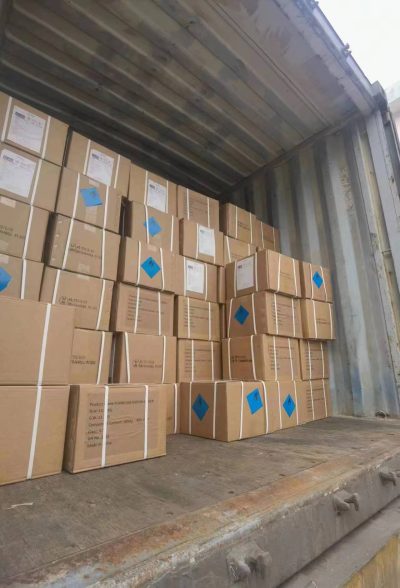
If you think this article is helpful, please contact us. We will give you reasonable and suitable product recommendations based on your current situation. If you are not sure, you can also consult us. We will provide you with professional services to answer your questions. You are welcome to consult us at any time and we welcome all customers to conduct on-site inspections!
FAQ’s
1.What is the melting point of polypropylene?
Polypropylene has a melting temperature range of about 160°C and 170°C (320°F to 338°F), depending on the relative crystallinity of the material.
2.How does crystallinity affect polypropylene’s melting temperature?
It partly determines the melting temperature as well. If the degree of crystallinity is raised the melt temperature will also be high because the polymer chains are closely aligned.
3.Can additives alter the melting point of polypropylene?
The melting point of this material, however, will decrease depending on some sources. For instance, plasticizers decrease the degree of crystalline structure, decreasing the melting point, while other would increase thermal stability of the material.
4.What is the significance of polypropylene’s melting temperature in injection molding processes?
When it comes to rapid injection molding the melting point is central in providing processing temperatures. Temperature refers with the operation condition that has significant impact on the flow, mold filling and the part produced.
5.How does molecular weight influence the melting temperature of polypropylene?
The higher the molecular weight of the polypropylene the higher is the melting point of the polymer. Polymer formation involves an increase in size of the material molecules and this implies that it is thermally stable and its melting point is high.
6.What are the recommended processing temperatures for polypropylene in industrial applications?
The temperature used in injection molding normally ranges from 180°C to 240°C (356°F to 464°F) for polypropylene depending with the grade used for processing.
7.What are the Applications of Polypropylene Relative to Melting Temperature?
Polypropylene used in automotive parts, packaging, and textiles, in which the melting point for application by injection molding and extrusion is of value. This is suitable for use in systems that need thermal barrier and material internal movement.
STAY IN THE LOOP